<?xml version="1.0" encoding="UTF-8"?>
<feed xmlns="http://www.w3.org/2005/Atom">
  <title type="text">Historic North Adams</title>
  <updated>2026-04-17T19:40:49+00:00</updated>
  <generator uri="http://framework.zend.com" version="1.12.20">Zend_Feed_Writer</generator>
  <link rel="alternate" type="text/html" href="https://historicnorthadams.com/"/>
  <link rel="self" type="application/atom+xml" href="https://historicnorthadams.com/items/browse?output=rss2"/>
  <id>https://historicnorthadams.com/</id>
  <author>
    <name>Historic North Adams</name>
    <uri>https://historicnorthadams.com</uri>
  </author>
  <link rel="hub" href="https://pubsubhubbub.appspot.com/"/>
  <entry>
    <title type="html"><![CDATA[Central Bowling Lanes]]></title>
    <summary type="html"><![CDATA[<img src="https://historicnorthadams.com/files/fullsize/5452afeeaa95927eeeb9a487d78c896f.jpg" alt="Two matchbooks for Central Bowling Alleys." /><br/><p>Central Bowling Lanes shared the top floor of the Martin Block with the Sons of Italy Lodge; two floors above the C. H. Cutting Company store on the corner of Main and State Street.  The owner and proprietor was Clyde Lentine who had purchased the business from Alphonse Thibert in the middle decade of the last century.
Clyde’s lanes were strictly for candlepins--the indoor sport so popular in North Adams before and after World War II. His lanes consisted of eight alleys of solid maple boards each an inch thick and three inches wide. Clyde charged his patrons 25 cents a game and he paid his pin boys a nickel a game. Later he installed automatic pinsetters but had to raise the price for bowling due to the royalties on the machine. Bowlers then paid a dollar for three games.
Central Bowling Lanes was the first bowling establishment in town to use maple pins with plastic bottoms. These pins did away with a grinding process that produced “shortpins” that were despised by bowlers when they produced weird “breaks” and poor scores.
Clyde opened his lanes at six o’clock on week nights and afternoons on weekends. There was junior league bowling on Saturday mornings; double leagues on Mondays and Tuesdays; one of them for women only. He had a Church League in which each bowler must be a church member.  March of Dimes events were held each year with donated prizes by merchants; bicycles and woolen cloth donated by the Strong-Hewitt company. During the March of Dimes events, bowlers who had less than six pins in a frame had to put a dime in the “kitty”. 
When it was announced that the Martin Block would be part of the urban renewal demolition, Clyde Lentine tried to sell the maple lanes, but it was found to be too expensive to move them from the building. When the building went down, so did the lanes themselves.</p><p><em>Adapted from a story for the North Adams Historical Society.</em>
</p><p><em><strong><a href="https://historicnorthadams.com/items/show/139">For more view the original article</a></strong></em></p>]]></summary>
    <published>2023-07-28T22:03:47+00:00</published>
    <updated>2026-04-17T19:40:48+00:00</updated>
    <link rel="alternate" type="text/html" href="https://historicnorthadams.com/items/show/139"/>
    <id>https://historicnorthadams.com/items/show/139</id>
    <author>
      <name> Roger W. Rivers</name>
    </author>
  </entry>
  <entry>
    <title type="html"><![CDATA[St. Andrew&#039;s Episcopal Chapel]]></title>
    <summary type="html"><![CDATA[<p><strong><em>Built as a missionary church in the village of Blackinton and associated with students from Williams College, St. Andrew's experienced a decline in the late twentieth century.</em></strong></p><img src="https://historicnorthadams.com/files/fullsize/bd0845304200d58686ec22a6e5d632bb.jpg" alt="Chapel exterior." /><br/><p>St. Andrew’s Episcopal Chapel was built in 1905 as a missionary church to St. John’s Episcopal church. St. Andrew’s was built to provide a closer Episcopal service for the growing population in the Blackinton area of North Adams. Before St. Andrew’s was built, service was originally being held in the home of Mrs. Eliza Thomas. When after two years the number of people attending service in the home of Mrs. Thomas became too large, the school hall was rented out. The capacity limit here was soon reached, so the community started a fund to collect money for a new building to be made. In early spring of 1905, on land donated by the Blackinton family, construction started to build a new chapel.
When St. Andrew’s Episcopal Chapel held its first service on Whitsunday of 1905, June 11<sup>th</sup>, there was no furniture and chairs had to be borrowed from Archer School hall. There was no door in the opening and cloth was nailed over the openings for windows. The Church began to receive furnishings mainly through gifts. The pews were given to St. Andrews from the old Williams College chapel, while the altar, lecterns and an organ came from St. John’s.
The first rector was Dr. J Franklin Carter, who with the help of Williams students ran the church. Dr. Carter was in charge of baptisms, marriage ceremonies, funeral services, confirmations, and visiting the sick. In 1915, there were 210 affiliated members with St. Andrew’s. That same year, Rev. Robert R. Carmichael became rector, his first parish assignment. After two years Rev. William Hall Williams replaced Rev. Carmichael. After seven years, he was replaced by William W. Smith, a lay-reader, who ran the church for 26 years until 1950. The church continued to be run by clergy affiliated with St. John’s and Williams College students after Smith’s retirement.
In 1955 the Church underwent renovations to its interior, kitchen, and roof. These repairs were made in anticipation of the church’s 50<sup>th</sup> anniversary service, which was was held on June 5<sup>th</sup> of that year. The church celebrated its 57<sup>th</sup> anniversary with only 50 people. The decline in membership continued in later decades, although St. Andrew’s continued to offer services until 2015. The Chapel is now used for Sunday services by the New Hope United Methodist Church.</p><p><em><strong><a href="https://historicnorthadams.com/items/show/90">For more (including 6 images) view the original article</a></strong></em></p>]]></summary>
    <published>2019-12-11T17:24:23+00:00</published>
    <updated>2026-04-17T19:40:48+00:00</updated>
    <link rel="alternate" type="text/html" href="https://historicnorthadams.com/items/show/90"/>
    <id>https://historicnorthadams.com/items/show/90</id>
    <author>
      <name>Abigail Berry</name>
    </author>
  </entry>
  <entry>
    <title type="html"><![CDATA[Calvin T. Sampson]]></title>
    <summary type="html"><![CDATA[<p><strong><em>Calvin T. Sampson, with little schooling, grew from a farmer in Vermont to one of North Adams' most prominent businessmen in the late 1800s.  </em></strong></p><img src="https://historicnorthadams.com/files/fullsize/6858d5c05dd341d93ab6b35eee12e3bd.jpg" alt="Calvin Sampson’s Family Grave   " /><br/><p>Born October 2, 1826 on a small family farm in Samford Vermont, Calvin Sampson became one of North Adams' wealthiest residents. </p><p>Sampson had very little schooling but was a vigorous reader and saved money for textbooks any chance he got.  He performed odd jobs around the farm, one of which was hauling wood four miles from his home into the village of North Adams.  This task would prove invaluable as he met friends along his route who “were useful in later (business) operations.”  Leaving behind a wife and children, Sampson’s father Calvin Sr. passed away when Sampson was just twenty years old.  His older brother Chester took over their family farm which was now over one hundred acres as their mother had inherited a little over forty-five acres from her parents. Sampson’s sister was also able to purchase some land, requiring Sampson to hire farm hands.  This act allowed Sampson to marry Julia Hayden of Clarksburg, Vermont three years later.  In the same year his cousin George Millard purchased a shoe factory in North Adams and asked Sampson to sell off some of the extra supplies housed in the building.  In 1850 Sampson and his family decided to sell their farm and move into North Adams, where he opened his own shoe shop a year later.</p><p>In 1851 he opened his first shoe store and within two years he began to make his own shoes. Sampson’s shoe industry took off with the purchase of the old plant on Marshalls street in 1869.  He worked as the president of the plant until 1891 when he retired and left the factory to the companies treasure George W. Chase.</p><p>Sampson’s career as a business man became a nationwide story when he decided to bring Chinese workers to North Adams to break the strike in his factory. Conflict with the labor union, known as the Knights of St. Crispin, began in 1868. The tension between Sampson and the Knights of St. Crispin continued over the next two years, ending in the year 1870, and lead to the strikes. The Sampson mill ended up discharging all known active members of the Knights of St. Crispin. To supplement the loss of workers Sampson brought in Chinese workers from San Francisco. The men and women workers who were brought to the Sampson Mill stayed in the area for ten years and numbered around 120 workers. Sampson’s Chinese workers were able to turn out more pairs of shoes at a higher rate of efficiency compared to the performance of the Crispins. The introduction of the Chinese workers into the North Adams workforce inspired many other business men to explore the idea of Chinese workers. Sampson’s humble beginnings as a shoe peddler going from house to house to a booming business man who was notorious for bringing in Chinese workers from the west coast and influencing others to do so.</p><p>Calvin T. Sampson passed away in 1893 and is buried in Hillside Cemetery. </p><p>Map Coordinates: 42.691575, -73.1247837</p><p><em><strong><a href="https://historicnorthadams.com/items/show/53">For more (including 8 images) view the original article</a></strong></em></p>]]></summary>
    <published>2019-01-24T19:20:33+00:00</published>
    <updated>2026-04-17T19:40:48+00:00</updated>
    <link rel="alternate" type="text/html" href="https://historicnorthadams.com/items/show/53"/>
    <id>https://historicnorthadams.com/items/show/53</id>
    <author>
      <name>Aletta Brown&amp;#32;&amp;amp;&amp;#32;Kate Vogel</name>
    </author>
  </entry>
  <entry>
    <title type="html"><![CDATA[Whitcomb Summit]]></title>
    <summary type="html"><![CDATA[<img src="https://historicnorthadams.com/files/fullsize/977e2bbe02b059319ea44b042a679f12.jpg" alt="In the Berkshires Whitcomb Summit Motor Lodge" /><br/><p>Looming over the Deerfield River Valley atop Whitcomb Summit there is a peculiar sight, a strange animal stands stalwart against the harsh winds and freezing temperature that persist at the highest point on the Mohawk Trail. On closer inspection, the creature reveals its true nature. For the animal in question is not quite as lively as expected, instead the figure is a statue casted in gleaming bronze depicting the noble Elk. Dedicated on June 17, 1923 the statue celebrates members of the Massachusetts Benevolent and Protective Order of Elks who died fighting in World War I. The statue honors their memories by remaining the one constant figure throughout Whitcomb Summit’s years of upheaval. Though the cabin and ownership may change hands, the Summit will stand, and the Elk will remain a beacon to travelers.</p><p>Whitcomb Summit was founded by early settlers to Western Massachusetts. The original Whitcomb family owned the property for decades, but on June 7, 1920 the Summit became what it is today. Transforming into one of the first roadside shops and reststops on the Mohawk Trail. With the rise of the personal automobile, Americans were now able to go on road trips to places that had past been disconnected from their lives entirely. Unfortunately, the sparse dirt roads of America could not properly accommodate these new cars.  To make up for this, roads were built across the country, including the Mohawk Trail of Massachusetts in 1914. These roads brought great opportunities for local business and the attractions sprung up to meet the surge of new travelers. That is where Whitcomb Summit was born, as a previously disconnected family-owned, high altitude retreat became a favorite spot for tourists and vacationers to sleep at or purchase souvenirs. </p><p>During Whitcomb Summit’s heyday the resort was positively packed. Cars would circulate as if it were a roadshow. However, those days could not last forever. Due to the rise of Interstate highways during the post WWII era as well as the cultural shift to get to places as fast as possible, Whitcomb Summit began to suffer like all scenic roadside locations. From the fifties onward, Whitcomb Summit changed hands every decade or so. However, there remain attempts to update and restore the aging Summit and continue its role as a leading Mohawk Trail destination.  </p><p><em><strong><a href="https://historicnorthadams.com/items/show/78">For more (including 4 images) view the original article</a></strong></em></p>]]></summary>
    <published>2019-01-24T19:26:55+00:00</published>
    <updated>2026-04-17T19:40:48+00:00</updated>
    <link rel="alternate" type="text/html" href="https://historicnorthadams.com/items/show/78"/>
    <id>https://historicnorthadams.com/items/show/78</id>
    <author>
      <name>Alex King</name>
    </author>
  </entry>
  <entry>
    <title type="html"><![CDATA[9-13 Eagle Street]]></title>
    <summary type="html"><![CDATA[<p><strong><em>Starting with a reputation as a great place to find seafood, 9-13 Eagle St. evolved to house long-standing clothing and jewelry shops.</p></strong></p><img src="https://historicnorthadams.com/files/fullsize/f76822dc6e2f24457f1cd87948fa03cb.jpg" alt="Photo of 9-13, circa 1970s" /><br/><p>Many different businesses resided at 9 Eagle Street that had an impact on the community over the course of the twentieth century. First known as Rope’s Fish Market in the 1920s and then Whitcomb’s Fish Market, it was finally bought as the Favreau Brother’s Market and renamed Saulnier’s Market in 1930 by Wilfred F. Saulnier who remained in charge for over thirty-five years of excellent service in North Adams. Saulnier’s specialized in seafood which is what they were known for. Wilfred Saulnier closed the market doors on September 2, 1967 after over thirty-five years of business in North Adams, leaving a mark on the community. </p><p>The property was then sold to John J. Levanos, proprietor of Jack’s Hot Dog Stand. In 1968 the space that used to be Saulnier’s Market was then renovated and made available for new business to come in. Center Sports Goods was looking to move from their Main Street location at the time so as a result, the owner Fred M. Levey decided to move the business to 9 Eagle Street in 1968. Center Sports Goods was at this location until they closed in the 1980s.</p><p>The jewelry stores that resided at 13 Eagle Street also made their mark on Eagle Street and the community of North Adams. First known as Pharmer’s Jewelers in the 1930s managed by Harry B. Jolley, this was later bought on February 8th 1943 and was renamed Jolley Jeweler’s. At that point it was owned by Harry B. Jolley and co-owned by his wife Elizabeth Jolley which shows how involved they were with their new business. Jolley sold everything from silver plates and silverware to wedding rings and watches. Jolley Jeweler’s closed its doors in May of 1971 and the property was put up for sale. </p><p>Louis and Susan Chalifoux were looking to open up their very own clothing store and 13 Eagle Street seemed like the very place to establish it. The Feminine Twist was opened in 1976 by another husband and wife dynamic duo at 13 Eagle Street eager and excited to get into the business scene. In the early 1980s they left 13 Eagle Street and moved to their location at 85 Main Street. Soon after the well-known Sprague Electric closed The Feminine Twist followed in 1985, leaving yet another legacy on Eagle Street and in the small town of North Adams Massachusetts.</p><p><em><strong><a href="https://historicnorthadams.com/items/show/48">For more (including 9 images) view the original article</a></strong></em></p>]]></summary>
    <published>2019-01-24T19:19:37+00:00</published>
    <updated>2026-04-17T19:40:48+00:00</updated>
    <link rel="alternate" type="text/html" href="https://historicnorthadams.com/items/show/48"/>
    <id>https://historicnorthadams.com/items/show/48</id>
    <author>
      <name>Allison Fortin</name>
    </author>
  </entry>
  <entry>
    <title type="html"><![CDATA[Blackinton Cemetery]]></title>
    <summary type="html"><![CDATA[<img src="https://historicnorthadams.com/files/fullsize/77e3391ed14f4b4d99b24420bd009ecb.jpg" alt="Gravesite of Sanford Blackinton&#039;s parents. " /><br/><p>The Blackinton Cemetery located on Massachusetts Avenue is one of the oldest known burial grounds in North Adams. It was originally a 100-acre farm owned by Deacon Otis Blackinton. He was the father of Sanford Blackinton, whose mills served as the heart of the Blackinton community in the nineteenth century. Most of the headstones in the Blackinton Cemetery are made up of crude fieldstone markers or marble, and many have suffered from weather and neglect. </p><p>The earliest known death date is said to be from all the way back to 1788, yet there are no more specifics on this gravestone. One of the original settlers of North Adams, Jeremiah Wilbur, is buried in the Blackinton Cemetery. The earliest death date with more specifics on the stone dates back to March 30, 1813.</p><p>Many of those who rest in the cemetery were brought to the village of Blackinton by Sanford Blackinton, the wealthy mill owner. Many of those who worked in the Blackinton Woolen Mill were “Yankees,” with a few Scottish, Irish, English and Welsh. Although these families were not much in number originally, Sanford Blackinton made his way over to Europe, specifically Wales, and recruited Welsh families in need of jobs and brought them back to North Adams to work at his mill. </p><p>After some time, word of these job opportunities spread and more Welsh families migrated to North Adams. The families and descendants of those recruitment workers from Wales now make up many of those whom are buried in Blackinton Cemetery.</p><p>By the 1960’s most family members of the deceased had moved away from North Adams. This made it harder to maintain the cemetery. In October, 1960, the cemetery had become so overgrown that 40 North Adams citizens started a committee that would speak about and organize what needed to be done in order to keep up with maintenance of the cemetery. These members consisted of Daniel C Barton, chairman, Hurbert Rudman, Stewart H. Lamon and Mrs. Stackpoole. </p><p>In recent years, the problem of maintaining the hilly and overgrown grave sites has resurfaced, and the City of North Adams has agreed to mow the cemetery. Headstones are now being cleaned and straightened by volunteers.</p><p><em><strong><a href="https://historicnorthadams.com/items/show/104">For more (including 7 images) view the original article</a></strong></em></p>]]></summary>
    <published>2019-12-12T10:19:39+00:00</published>
    <updated>2026-04-17T19:40:48+00:00</updated>
    <link rel="alternate" type="text/html" href="https://historicnorthadams.com/items/show/104"/>
    <id>https://historicnorthadams.com/items/show/104</id>
    <author>
      <name>Alyssa Eden</name>
    </author>
  </entry>
  <entry>
    <title type="html"><![CDATA[North Adams Fairgrounds]]></title>
    <summary type="html"><![CDATA[<p><strong><em>I see London, I see France, I see… North Adams? In the early twentieth century, all three were almost equally popular tourist destinations for the same reason</em></strong></p><img src="https://historicnorthadams.com/files/fullsize/9a245912a1b8967af9027d27331640cd.jpg" alt="Hot Air Ballooning" /><br/><p>In the fall of 1927, heavy amounts of rainfall created massive flooding in the Hoosic River, and the rushing water completely obliterated a piece of North Adams history. This piece of history was the Fairgrounds, the site for a variety of events that drew tens of thousands of people to North Adams each year. The Fairgrounds held everything from the annual Agricultural Society Cattle Show and Fair to the Ringling Brothers Circus to hot air balloon races. The Fairgrounds were such a big draw around the nation that William McKinley visited the Agricultural Fair in 1897, the first year of his presidency.</p><p>The Hoosac Valley Agricultural Society Cattle Show and Fair was one of the largest regular events to occur in Berkshire county. At its high point in 1911, the fair had 14,000 visitors in one day. Events at the fair included carriage racing, horse shows, and competitions for best animals and produce. In addition, farmers across the Hoosac Valley gathered at the fair to sell their products, ranging from fruits and vegetables that they had grown to clothing that they had made. Any stalls or vendors outside the fair were banned for up to a mile in any direction so as to draw more people in, although attendance was not an issue until the fairs last years.</p><p>Even more popular than the Agricultural Fair in North Adams was hot air ballooning. Here the fairgrounds served as a hub of sorts, being a large enough area of land for balloons to take off and land. However, ballooning was present in many other areas of North Adams as well. In fact, North Adams was one of the most popular places for hot air ballooning in the United States, on par with Paris and London, the centers for hot air ballooning in Europe. One of the biggest events to occur in North Adams history was the hot air balloon race of 1908, in which three air balloons raced from point to point, making it the first place in the country to host such an event. Hot air ballooning continued in North Adams after the fairgrounds were destroyed, but slowly fizzled out when the activity fell out of fashion.</p><p>Unfortunately, most of this rich history was lost in the flood of 1927. Due to the poor location of the fairgrounds, with the Hoosic River running right behind it, any time the river would flood there would be damage to the grounds. This grew to be a problem in the 1920s, as the river flooded more and more often, and came to a head in 1927, when a record-breaking flood caused irreversible damage. After they were cleared, Sprague Electric bought the fairgrounds in the 1930s and used them as a dumping ground for industrial waste, thus destroying any chance for the revival of the Fairgrounds in the future.</p><p><em><strong><a href="https://historicnorthadams.com/items/show/71">For more (including 6 images) view the original article</a></strong></em></p>]]></summary>
    <published>2019-01-24T19:25:09+00:00</published>
    <updated>2026-04-17T19:40:48+00:00</updated>
    <link rel="alternate" type="text/html" href="https://historicnorthadams.com/items/show/71"/>
    <id>https://historicnorthadams.com/items/show/71</id>
    <author>
      <name>Amanda Judson</name>
    </author>
  </entry>
  <entry>
    <title type="html"><![CDATA[St. Anthony of Padua Catholic Church]]></title>
    <summary type="html"><![CDATA[<p><strong><em>Two churches were built as Italian immigrants and their children looked to establish their place in the city.  </em></strong></p><img src="https://historicnorthadams.com/files/fullsize/fe3b1c584229f55856a815102cd5ec17.jpg" alt="Procession at St. Anthony's" /><br/><p>At the beginning of the twentieth century, the growing population of Italian Catholics in North Adams built the original St. Anthony’s at 100 Holden Street. The first service was held in 1906 and the founding pastor was Rev. Peter Pillarella. The published history of the parish describes it as "a quaintly beautiful structure situated well back from the noise of the street." The community grew under the leadership of Rev. William Lattanzi from 1910-1922. </p><p>In the prosperous years after World War II, a parish building committee led by Joseph R. Bianco and Henry J. Pierpan Sr. sought to raise funds for a bigger church. Land was secured at 70 Marshall Street, and in 1958 the new and bigger structure was dedicated on June 13 (the feast of St. Anthony) by Bishop Christopher Weldon.</p><p>For many years, LaFesta was a popular Italian-American festival that was hosted by St. Anthony’s, and it was a significant cultural experience for parishioners and also many visitors. LaFesta was meant to showcase Italian culture, and how grateful people were to be able to call themselves Italians. </p><p>In 1950, the basketball team representing St. Anthony’s won a championship, led by the beloved priest, Father Armando Russo, and this championship garnered them a visit from the College of the Holy Cross basketball squad which included basketball legend Bob Cousy.
The decline in the number of Catholics in North Adams in recent decades led to the consolidation of parishes in 2009. St. Anthony's is the sole remaining the sole Catholic church in North Adams and the church and parish are now known as St. Elizabeth of Hungary.</p><p><em><strong><a href="https://historicnorthadams.com/items/show/103">For more (including 7 images) view the original article</a></strong></em></p>]]></summary>
    <published>2019-12-12T09:44:56+00:00</published>
    <updated>2026-04-17T19:40:48+00:00</updated>
    <link rel="alternate" type="text/html" href="https://historicnorthadams.com/items/show/103"/>
    <id>https://historicnorthadams.com/items/show/103</id>
    <author>
      <name>Andrew Lavelle</name>
    </author>
  </entry>
  <entry>
    <title type="html"><![CDATA[Stories from the Sprague Log: 1944:  News and Letters from the Armed Forces ]]></title>
    <summary type="html"><![CDATA[<p><strong><em>The “News and Letters from the Armed Forces” section was a recurring feature in every <em>Sprague Log</em> published in 1944. Everything from experiences, updates, and showing their appreciation for the newsletter was featured in this section.</em></strong></p><img src="https://historicnorthadams.com/files/fullsize/6ee6c8958231c5823408dcda72371bcb.jpg" alt="&quot;The Letters and News from the Armed Forces&quot; section, November 25, 1944" /><br/><p><span style="font-size:13.5pt;font-family:Times;color:#000000;">In 1944, there was a recurring section that gave updates and firsthand letters from former workers in the <i>Sprague Log</i> company newsletter. This section went by a few different names, such as “Letters and News from the Armed Forces,” or “News From Our Workers In Service,” but featured the same content. These letters served as a way for workers who currently worked at Sprague to hear directly from some of the former coworkers. Along with letters, this section also gave updates about workers, with some focus on former workers lost in service or reported missing. It also showed pictures of some workers and gave some positive updates as well. </span>

<span style="font-size:13.5pt;font-family:Times;color:#000000;">We see in the January 8th, 1944, log that there are a few different former workers’ pictures featured in this section. This section was meant for current workers to be able to see where some of their friends were stationed and even get to hear from them through the letters. Again, in the January 8th log, we hear from Lt. Louis A. Gazzaniga, who gives updates on what his experience have been like during their time overseas. While this section was meant for workers, we see a great appreciation from the workers’ writing in as well.</span>

<p style="text-decoration-thickness:initial;text-decoration-style:initial;text-decoration-color:initial;word-spacing:0px;"><span style="font-size:13.5pt;font-family:Times;color:#000000;">The letters were coming in from former workers of Sprague who were stationed all around the world. In every newsletter, there are multiple letters under the “News From Our Workers In Service,” everything from talking about their experiences, to where they were stationed, and even how much they appreciated gifts, such as cigarettes, that were sent to them. One common theme that continued to recur during these messages was how much these military workers enjoyed receiving the <i>Sprague Log</i>. We hear from Pvt. Calvin W. Aubertine in the November 25th, 1944, log, where he says, “it sure makes a fellow feel good to read how the old plant is doing.” With these workers across the world, the <i>Sprague Log</i> gave them some sense of normality. Another service member who showed his appreciation was Cpl. Harold Sharron in the March 25 log, who wrote, “I enjoy the copies very much and hope you will continue to send them.” </span>

<span style="font-size:13.5pt;font-family:Times;color:#000000;">The letters published in the <i>Sprague Log</i> were greatly appreciated by the former workers in service. It gave them updates about how Sprague was doing and what was going on in North Adams, while also being able to share updates of their own through the “Letters and News from the Armed Forces” section of the <i>Sprague Log</i>.</span>
</p><p><em><strong><a href="https://historicnorthadams.com/items/show/216">For more (including 4 images) view the original article</a></strong></em></p>]]></summary>
    <published>2026-02-25T21:31:56+00:00</published>
    <updated>2026-04-17T19:40:49+00:00</updated>
    <link rel="alternate" type="text/html" href="https://historicnorthadams.com/items/show/216"/>
    <id>https://historicnorthadams.com/items/show/216</id>
    <author>
      <name>Andrew Mayberry, Sam Broderick,&amp;#32;&amp;amp;&amp;#32;Benjamin Macfadzen</name>
    </author>
  </entry>
  <entry>
    <title type="html"><![CDATA[NASC Hockey: The Jump to Division II]]></title>
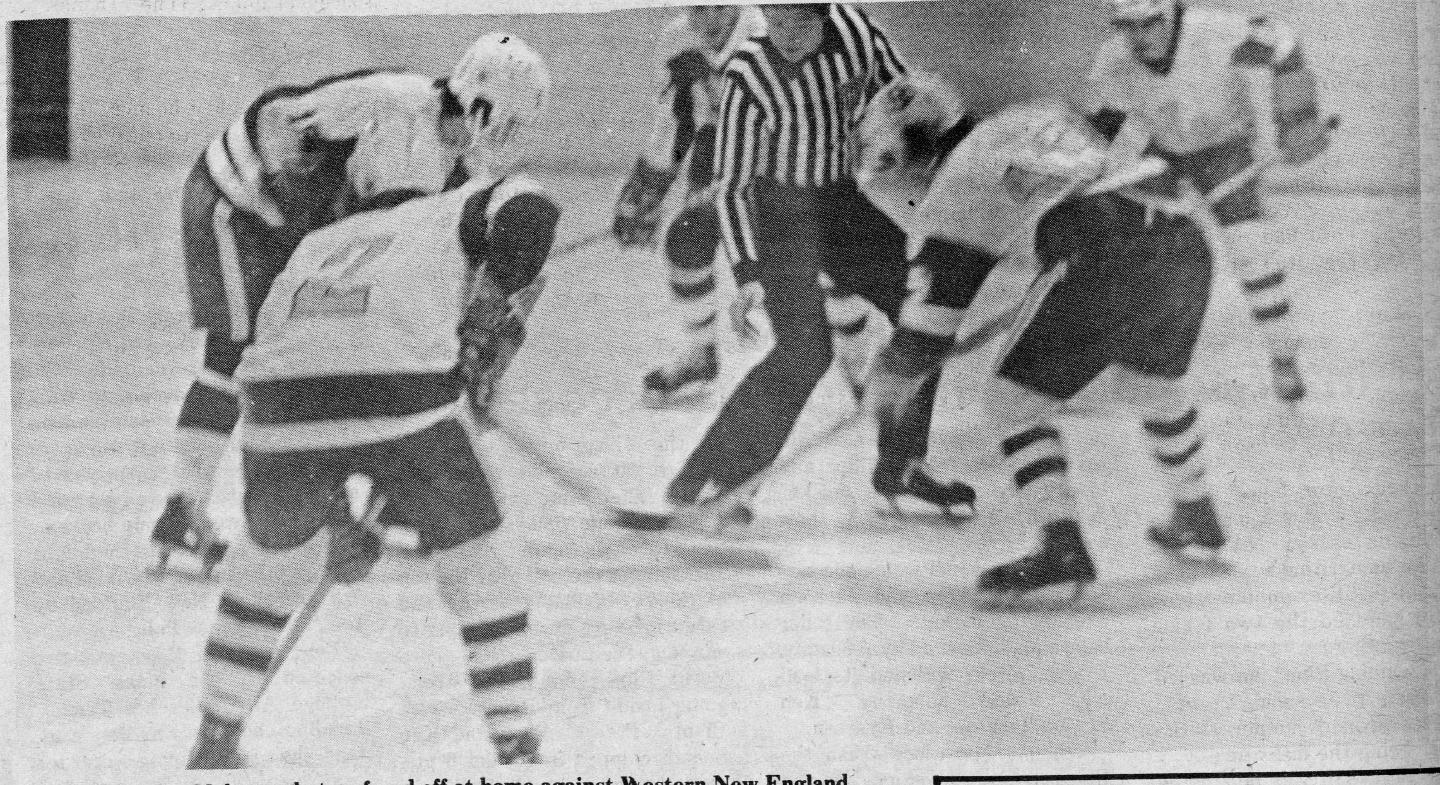
    <summary type="html"><![CDATA[<p><strong><em>Did you know that MCLA hockey was once competing at the Division II level? In 1975, the then North Adams State Mohawks made the leap from Division III to Division II with mixed results.</em></strong></p><img src="https://historicnorthadams.com/files/fullsize/94aec29c768eaeecc000c35cd0555c3c.jpg" alt="Face off." /><br/><p>One of the most interesting spans in MCLA (then North Adams State College) hockey history was 1975-1977. After 3 successful seasons, the program felt they were ready for a change.</p><p>In 1975, the school submitted a letter to the board requesting that they be moved up to Division II after having a winning record the year prior against Division II opponents and finishing runner-up in Division III. It was accepted, and starting in the 1975-76 season, they would now be a part of Division II.</p><p>This was a big step up, but it was also a major success for the hockey program. They believed by moving up to Division II, they would be able to get more recruits due to the better competition they would be playing against. The better players that came to the program, the more success it could have. At the time, North Adams State’s roster was made up mostly of students from eastern Massachusetts and the greater Boston area. They believed that if they were to make this jump, a wider array of players would consider coming here to play hockey. </p><p>With the team already playing against some Division II opponents in prior years and having some success, it was expected that success would translate in the 1975-76 season. However, that largely did not turn out to be the case. The Mohawks would finish with an overall positive record, going 11-10, but their Division II record saw only 3 wins to 9 losses. It was a rough first season as a Division II team, but they would continue to try and improve in the 1976-77 season. </p><p>The second season went a little better and was much more well-documented. The Mohawks started off the season strong with a 6-2 win over New England College of New Hampshire. The Mohawks then fell to New Haven in game 2, followed by a dominating win over Bridgewater State 8-1, with Freshman center Jack Sheehan scoring a hat trick in the game. By Christmas break, the team exceeded last season's Division II win total at 5-3, and 6-3 overall. This was a big step and made the Mohawks a threat in their conference. </p><p>This success did not last long, though, as the Mohawks dropped back-to-back games after Christmas break. A 6-3 loss to Oswego State and a 6-5 overtime loss to Bishop’s University of Canada in the Williams College Christmas tournament would put the school at just 6-5 overall and 5-5 in Division II. Unfortunately for the Mohawks, things did not get much better for the rest of the season; they would only be able to capture one more victory at the Division II level. </p><p>Coach Jim Ellingwood's squad struggled, even losing a game 13-4 to UConn. This was the largest number of goals scored against them in their first two seasons in Division II. They would finish the season with a 6-10 record in Division II, but a 14-11 overall record. They capped off a frustrating season with a 13-3 win over Framingham State. </p><p>Even with the disappointing end, there was still improvement from the season prior. Although the team struggled in their first two seasons of Division II competition, they would continue to compete and have successful seasons in following years.</p><p><em><strong><a href="https://historicnorthadams.com/items/show/220">For more (including 5 images) view the original article</a></strong></em></p>]]></summary>
    <published>2026-04-06T04:21:20+00:00</published>
    <updated>2026-04-17T19:40:49+00:00</updated>
    <link rel="alternate" type="text/html" href="https://historicnorthadams.com/items/show/220"/>
    <id>https://historicnorthadams.com/items/show/220</id>
    <author>
      <name>Andrew Mayberry</name>
    </author>
  </entry>
</feed>